How to Read a Ct Scan of the Heart
Cardiac CT for Calcium Scoring
Cardiac computed tomography (CT) for Calcium Scoring uses special 10-ray equipment to produce pictures of the coronary arteries to decide if they are blocked or narrowed by the buildup of plaque – an indicator for atherosclerosis or coronary avenue illness (CAD). The information obtained tin help evaluate whether you are at increased adventure for heart assail.
Tell your doctor if there'south a possibility yous are significant and discuss any contempo illnesses, medical conditions, medications you're taking, and allergies. You will be instructed not to swallow or drink anything and to avert caffeine and smoking for four hours prior to the exam. Leave jewelry at home and wear loose, comfortable clothing. Yous may be asked to clothing a gown.
- What is Cardiac CT for Calcium Scoring?
- What are some common uses of the procedure?
- How should I set?
- What does the equipment look similar?
- How does the procedure piece of work?
- How is the procedure performed?
- What volition I experience during and after the procedure?
- Who interprets the results and how do I go them?
- What are the benefits vs. risks?
- What are the limitations of Cardiac CT for Calcium Scoring?
- Which test, process or handling is all-time for me?
What is Cardiac CT for Calcium Scoring?
Computed tomography, more commonly known as a CT or CAT scan, is a diagnostic medical imaging test. Similar traditional x-rays, information technology produces multiple images or pictures of the inside of the body.
A CT browse generates images that can be reformatted in multiple planes. It can even generate iii-dimensional images. Your doctor can review these images on a computer monitor, print them on film or via a 3D printer, or transfer them to a CD or DVD.
CT images of internal organs, basic, soft tissue, and blood vessels provide greater item than traditional x-rays. This is especially true for soft tissues and blood vessels.
Wear comfy, loose-fitting wear to your examination. You may need to change into a gown for the procedure.
Metallic objects, including jewelry, eyeglasses, dentures, and hairpins, may affect the CT images. Leave them at dwelling house or remove them prior to your exam. Some CT exams will require you to remove hearing aids and removable dental work. Women will need to remove bras containing metal underwire. You may demand to remove any piercings, if possible.
A cardiac CT scan for coronary calcium is a non-invasive manner of obtaining information nigh the presence, location and extent of calcified plaque in the coronary arteries—the vessels that supply oxygen-containing blood to the heart musculus. Calcified plaque results when there is a build-upward of fat and other substances nether the inner layer of the artery. This material tin calcify which signals the presence of atherosclerosis, a disease of the vessel wall, also called coronary artery illness (CAD). People with this disease accept an increased adventure for heart attacks. In add-on, over time, progression of plaque build up (CAD) tin narrow the arteries or fifty-fifty close off claret menses to the centre. The result may be chest pain, sometimes called "angina," or a eye assault.
Considering calcium is a marking of CAD, the amount of calcium detected on a cardiac CT scan is a helpful prognostic tool. The findings on cardiac CT are expressed as a calcium score. Some other name for this test is coronary artery calcium scoring.
superlative of folio
What are some common uses of the procedure?
The goal of cardiac CT scan for calcium scoring is to decide if CAD is nowadays and to what extent, fifty-fifty if at that place are no symptoms. It is a screening study that may exist recommended by a physician for patients with risk factors for CAD but no clinical symptoms.
The major run a risk factors for CAD are:
- high blood cholesterol levels
- family history of heart attacks
- diabetes
- high claret pressure
- cigarette smoking
- overweight or obese
- concrete inactivity
top of page
How should I set?
No special grooming is necessary in advance of a cardiac CT examination. You should continue to take your usual medications, but should avoid caffeine and smoking for four hours prior to the exam.
Wearable comfy, loose-fitting clothing to your exam. You may need to change into a gown for the procedure.
Metal objects, including jewelry, eyeglasses, dentures, and hairpins, may impact the CT images. Leave them at dwelling house or remove them prior to your exam. Some CT exams will require you to remove hearing aids and removable dental piece of work. Women will need to remove bras containing metal underwire. Yous may demand to remove whatsoever piercings, if possible.
Women should always inform their physician and the CT technologist if at that place is any possibility that they may be pregnant. See the CT Safety During Pregnancy page for more information.
top of page
What does the equipment look similar?
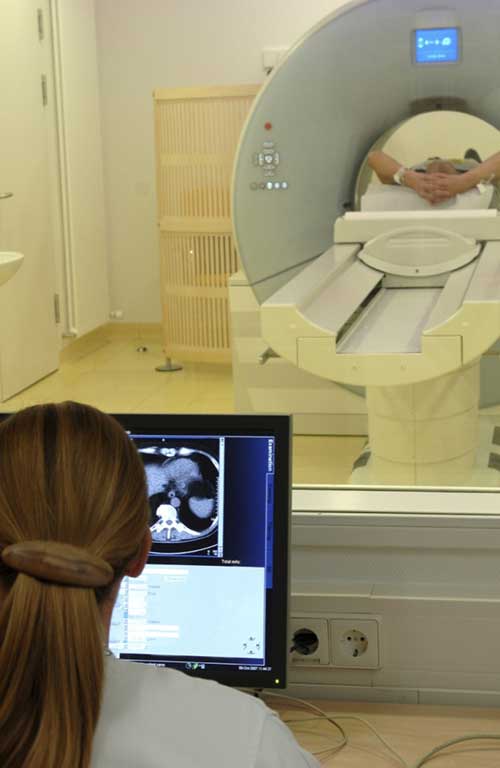
The CT scanner is typically a large, donut-shaped machine with a short tunnel in the center. You will lie on a narrow table that slides in and out of this brusque tunnel. Rotating around you, the x-ray tube and electronic x-ray detectors are located opposite each other in a ring, called a gantry. The computer workstation that processes the imaging data is in a dissever command room. This is where the technologist operates the scanner and monitors your examination in direct visual contact. The technologist volition exist able to hear and talk to you lot using a speaker and microphone.
top of page
How does the process work?
In many ways CT scanning works very much similar other x-ray examinations. X-rays are a course of radiation—like light or radio waves—that can be directed at the body. Different trunk parts blot the ten-rays in varying degrees.
In a conventional x-ray exam, a small outburst of radiations is aimed at and passes through the body, recording an epitome on photographic film or a special image recording plate. Basic appear white on the x-ray; soft tissue shows up in shades of gray and air appears black.
With CT scanning, numerous x-ray beams and a gear up of electronic x-ray detectors rotate around you, measuring the corporeality of radiation beingness absorbed throughout your body. The scanner will take a set of images and so the tabular array will move (axial scan). Sometimes the examination tabular array volition motility during the scan and then that the 10-ray beam follows a screw path (spiral or helical browse). A special reckoner program processes this large volume of information to create two-dimensional cross-sectional images of your body, which are and so displayed on a monitor.
CT imaging is sometimes compared to looking into a loaf of bread by cutting the loaf into sparse slices. When the image slices are reassembled by figurer software, the result is a very detailed multidimensional view of the torso's interior.
Refinements in detector technology allow new CT scanners to obtain multiple slices in a single rotation. These scanners, called multislice CT or multidetector CT, allow thinner slices to be obtained in a shorter catamenia of time, resulting in more detail and additional view capabilities.
Mod CT scanners are and then fast that they can scan through large sections of the body in just a few seconds. Such speed is benign for all patients only especially children, the elderly and critically ill.
Electron axle computed tomography (EBCT) is an alternative to conventional CT for measuring coronary calcium. In EBCT, an electron beam is sent to a target band located around the patient. The beam creates x-rays at the target rings, which radiate through the patient to the detector on the opposite cease of the scan tube. Because the automobile has no moving parts, it can larn as many as xx images every second—fast plenty and then that it avoids any blurring caused by the beating of the center. While EBCT and CT take been shown to take similar accuracy in determining calcium scores, EBCT is non as commonly available, as information technology is less versatile than the latest generation of high-speed CT scanners.
tiptop of page
How is the process performed?
The technologist begins by positioning you on the CT exam tabular array, usually lying flat on your dorsum. They may use straps and pillows to aid you maintain the correct position and remain still during the examination.
Electrodes (small, gummy discs) volition be attached to your chest and to an electrocardiograph (ECG) motorcar that records the electric activeness of the heart. This makes it possible to tape CT scans when the heart is not actively contracting.
Adjacent, the table will motility quickly through the scanner to determine the correct starting position for the scans. Then, the tabular array volition move slowly through the machine for the bodily CT browse. Depending on the blazon of CT scan, the auto may brand several passes.
Patients are asked to hold their breath for a period of ten to 20 seconds while images are recorded.
When the exam is complete, the technologist will enquire you to await until they verify that the images are of loftier enough quality for accurate interpretation by the radiologist.
The unabridged procedure including the actual CT scanning is usually completed within 10 minutes.
For an EBCT scan, you will lie on a table under an arch-shaped scanner. Y'all may remain clothed and your caput will non exist enclosed at any time. During the scan, you will be asked to agree your breath at times to help you remain motionless. The procedure takes nearly 10 to 15 minutes, although the actual scanning fourth dimension is only a few seconds.
top of folio
What will I feel during and after the procedure?
This CT examination is painless, fast and easy.
Though the scan is painless, you may have some discomfort from remaining nonetheless for several minutes or from placement of an IV. If y'all have a hard time staying still, are very nervous, broken-hearted, or in pain, you may find a CT examination stressful. The technologist or nurse, under the management of a doctor, may offer you some medication to help you tolerate the CT exam.
When you enter the CT scanner, you may see special calorie-free lines projected onto your body. These lines help ensure that y'all are in the correct position on the examination tabular array. With mod CT scanners, yous may hear slight buzzing, clicking and whirring sounds. These occur every bit the CT scanner's internal parts, non usually visible to you lot, revolve around y'all during the imaging procedure.
You will exist alone in the examination room during the CT scan, unless there are special circumstances. For example, sometimes a parent wearing a lead shield may stay in the room with their kid. Nonetheless, the technologist will ever be able to run across, hear and speak with you through a born intercom organisation.
After the CT test, you tin return to your normal activities.
top of page
Who interprets the results and how do I get them?
A radiologist, a doctor specially trained to supervise and interpret radiology exams, will analyze the images. The radiologist will send an official report to the doctor who ordered the exam.
A negative cardiac CT scan for calcium scoring shows no calcification inside the coronary arteries. This suggests that CAD is absent-minded or so minimal it cannot be seen past this technique. The chance of having a heart attack over the next two to five years is very low under these circumstances.
A positive test means that CAD is present, regardless of whether or not the patient is experiencing any symptoms. The corporeality of calcification—expressed as the calcium score—may help to predict the likelihood of a myocardial infarction (heart attack) in the coming years and helps your medical md or cardiologist make up one's mind whether the patient may need to have preventive medicine or undertake other measures such as nutrition and practise to lower the chance for heart attack.
The extent of CAD is graded according to your calcium score:
| Calcium Score | Presence of CAD |
| 0 | No testify of CAD |
| ane-10 | Minimal prove of CAD |
| xi-100 | Mild evidence of CAD |
| 101-400 | Moderate evidence of CAD |
| Over 400 | Extensive bear witness of CAD |
You may need a follow-up examination. If and so, your doc will explain why. Sometimes a follow-up examination farther evaluates a potential issue with more views or a special imaging technique. Information technology may besides meet if at that place has been any alter in an consequence over time. Follow-up exams are frequently the all-time way to see if treatment is working or if a problem needs attending.
summit of page
What are the benefits vs. risks?
Benefits
- Cardiac CT for calcium scoring is a convenient and noninvasive way of evaluating whether you may be at increased risk for a heart assault.
- The exam takes lilliputian time, causes no pain, and does not require injection of dissimilarity material.
- An EBCT scan takes less than twenty minutes and you can return to normal activities immediately afterward.
- No radiation remains in a patient'south body later on a CT exam.
- The x-rays used for CT scanning should have no immediate side effects.
Risks
- In that location is ever a slight risk of cancer from excessive exposure to radiation. However, the benefit of an authentic diagnosis far outweighs the risk involved with CT scanning.
- The radiation dose for this process varies. See the Radiations Dose in Ten-Ray and CT Exams folio for more information about radiations dose.
- Women should always tell their doctor and x-ray or CT technologist if in that location is any chance they are pregnant. See the Safety in X-ray, Interventional Radiology and Nuclear Medicine Procedures page for more than data about pregnancy and ten-rays.
- Doctors do non more often than not recommend CT scanning for meaning women unless medically necessary because of potential risk to the unborn baby.
- A loftier calcium score may sometimes be followed by other diagnostic tests for center disease, which may or may not provide results with clinical value and tin can exist associated with side effects.
top of page
What are the limitations of Cardiac CT for Calcium Scoring?
A person who is very large may non fit into the opening of a conventional CT scanner. Or, they may exist over the weight limit—usually 450 pounds—for the moving tabular array.
CAD, especially in people below 50 years of age can be present without calcium (non-calcified plaque) and may not be detected by this examination.
Not all health insurance plans cover cardiac CT for calcium scoring.
A loftier heart rate may interfere with the image quality of the exam.
Exactly how your treatment or prevention for heart attacks should be modified according to your calcium score remains uncertain.
EBCT scanners have fewer rows of detectors and lack the spatial resolution of the latest generation CT scanners.
top of page
top of page
This page was reviewed on January, 28, 2020
Images
Pediatric Content
Some imaging tests and treatments have special pediatric considerations. The teddy bear denotes kid-specific content.
- RadInfo iv Kids
Sponsored By


Please notation
RadiologyInfo.org is non a medical facility. Please contact your md with specific medical questions or for a referral to a radiologist or other doc. To locate a medical imaging or radiation oncology provider in your customs, you can search the ACR-accredited facilities database.
This website does non provide cost information. The costs for specific medical imaging tests, treatments and procedures may vary by geographic region. Talk over the fees associated with your prescribed procedure with your doctor, the medical facility staff and/or your insurance provider to become a amend agreement of the possible charges you will incur.
Web folio review procedure: This Spider web folio is reviewed regularly by a physician with expertise in the medical area presented and is further reviewed by committees from the Radiological Society of North America (RSNA) and the American Higher of Radiology (ACR), comprising physicians with expertise in several radiologic areas.
Outside links: For the convenience of our users, RadiologyInfo.org provides links to relevant websites. RadiologyInfo.org, RSNA and ACR are non responsible for the content contained on the spider web pages found at these links.
Source: https://www.radiologyinfo.org/en/info/ct_calscoring
0 Response to "How to Read a Ct Scan of the Heart"
ارسال یک نظر