I Think We Started Something I Wanna Tell the World Again
| "I Desire to Tell You" | |
|---|---|
 Cover of the Northern Songs canvas music (licensed to Sonora Musikförlag) | |
| Song by the Beatles | |
| from the anthology Revolver | |
| Released | v Baronial 1966 |
| Recorded | 2–3 June 1966 |
| Studio | EMI, London |
| Genre | Psychedelic rock |
| Length | 2:29 |
| Label | Parlophone |
| Songwriter(south) | George Harrison |
| Producer(s) | George Martin |
"I Want to Tell Y'all" is a vocal by the English rock group the Beatles from their 1966 album Revolver. Information technology was written and sung past George Harrison, the ring'south atomic number 82 guitarist. After "Taxman" and "Love You To", it was the third Harrison composition recorded for Revolver. Its inclusion on the LP marked the outset fourth dimension that he was allocated more than than two songs on a Beatles album, a reflection of his continued growth equally a songwriter beside John Lennon and Paul McCartney.
When writing "I Want to Tell You", Harrison drew inspiration from his experimentation with the hallucinogenic drug LSD. The lyrics address what he later on termed "the barrage of thoughts that are and so hard to write down or say or transmit".[1] In combination with the vocal's philosophical bulletin, Harrison'southward stuttering guitar riff and the dissonance he employs in the melody reflect the difficulties of achieving meaningful communication. The recording marked the first time that McCartney played his bass guitar part later the band had completed the rhythm track for a song, a technique that became commonplace on the Beatles' subsequent recordings.
Amid music critics and Beatles biographers, many writers have admired the group'due south performance on the rails, particularly McCartney'south use of Indian-style vocal melisma. Harrison performed "I Want to Tell Y'all" as the opening song throughout his 1991 Japanese tour with Eric Clapton. A version recorded during that tour appears on his Live in Nihon album. At the Concert for George tribute in November 2002, a year after Harrison'due south death, the song was used to open the Western portion of the effect, when it was performed by Jeff Lynne. Ted Nugent, the Smithereens, Thea Gilmore and the Melvins are amid the other artists who have covered the track.
Background and inspiration [edit]
George Harrison wrote "I Want to Tell You" in the early on part of 1966, the yr in which his songwriting matured in terms of subject field matter and productivity.[2] Equally a secondary composer to John Lennon and Paul McCartney in the Beatles,[3] Harrison began to constitute his own musical identity through his absorption in Indian culture,[4] [5] equally well equally the perspective he gained through his experiences with the hallucinogenic drug lysergic acrid diethylamide (LSD).[six] Co-ordinate to writer Gary Tillery, the song resulted from a "creative surge" that Harrison experienced at the commencement of 1966.[vii] During the same period, the Beatles had been afforded an unusually long time costless of professional commitments[8] [9] due to their determination to reject A Talent for Loving equally their third pic for United Artists.[10] Harrison used this time to study the Indian sitar and, like Lennon, to explore philosophical issues in his songwriting while preparing to tape the band's next album, Revolver.[11]
In his autobiography, I, Me, Mine, Harrison says that "I Want to Tell Y'all" addresses "the avalanche of thoughts that are so difficult to write downward or say or transmit".[1] [12] Authors Russell Reising and Jim LeBlanc cite the song, along with "Rain" and "Inside You lot Without You lot", as an early example of the Beatles abandoning "coy" statements in their lyrics and instead "adopt[ing] an urgent tone, intent on channeling some essential knowledge, the psychological and/or philosophical epiphanies of LSD experience" to their listeners.[13] Writing in The Beatles Anthology, Harrison likened the outlook inspired past his taking the drug to that of "an astronaut on the moon, or in his spaceship, looking back at the Globe. I was looking dorsum to the Earth from my awareness."[fourteen]
Author Robert Rodriguez views the song as reflecting the furnishings of Harrison'due south search for increased awareness, in that "the faster and more than broad-reaching his thoughts came, the greater the struggle to find the words to express them".[15] As reproduced in I, Me, Mine,[16] Harrison's original lyrics were more direct and personal, compared with the philosophical focus of the completed song.[17] The latter has nevertheless invited interpretation as a standard love song, in which the singer is cautiously inbound into a romance.[18] Another interpretation is that the theme of miscommunication was a statement on the Beatles' difference from their audience, during a fourth dimension when the group had tired of performing concerts before screaming fans.[19] [20]
Composition [edit]
Music [edit]
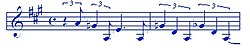
Musical notation for the song's guitar riff. Author Simon Leng considers that the unusual "stuttering" aspect in this recurring passage mirrors the search for adequate words expressed in Harrison'due south lyrics.[21]
"I Want to Tell You lot" is in the cardinal of A major[22] and in a standard fourth dimension signature of 4/iv.[23] It contains a low-register, descending guitar riff that music journalist Richie Unterberger describes as "circular, full" and "typical of 1966 British mod rock".[24] The riff opens and closes the song and recurs betwixt the verses.[23] Particularly over the introduction, the rests between the riff's syncopated notes create a stammering upshot. The metric anomalies suggested by this effect are borne out farther in the uneven, eleven-bar length of the poesy.[25] The master portion of the vocal consists of two verses, a bridge (or middle eight),[26] followed by a poetry, a second span and the concluding verse.[23]
The vocal was virtually the frustration we all feel about trying to communicate sure things with merely words. I realised that the chords I knew at the time simply didn't capture that feeling. I came up with this dissonant chord [E7 ♭ 9] that really echoed that sense of frustration.[27]
– George Harrison, 2001
Co-ordinate to Rodriguez, "I Desire to Tell Y'all" is an early example of Harrison "matching the music to the message",[twenty] every bit aspects of the song'southward rhythm, harmony and structure combine to convey the difficulties in achieving meaningful communication.[23] [26] [nb 1] Equally in his 1965 composition "Call back for Yourself", Harrison's pick of chords reflects his involvement in harmonic expressivity.[31] The verse opens with a harmonious E-A-B-C#-Due east melody-note progression over an A major chord, after which the melody begins a harsh ascent[18] with a move to the II7 (B7) chord.[32] Farther to the off-kilter quality of the opening riff, musicologist Alan Pollack identifies this chord change as part of the disorientating characteristics of the verses, due to the change occurring midway through the fourth bar, rather than at the start of the measure.[23] The musical and emotional dissonance is then heightened by the employ of E7 ♭ 9,[32] a chord that Harrison said he happened upon while striving for a audio that adequately conveyed a sense of frustration.[27] [nb two] With the render to the I chord for the guitar riff, the harmonic progression through the verse suggests what author Ian MacDonald terms "an Oriental variant of the A major scale" that is "more Arabic than Indian".[26]
The centre eight sections present a softer harmonic content relative to the strident progression over the verses.[18] The tune encompasses B pocket-sized, diminished and major 7 chords, together with A major.[23] The inner voicings within this chord pattern produce a chromatic descent of notes through each semitone from F ♯ to C ♯ .[35] Musicologist Walter Everett comments on the aptness of the conciliatory lyric "Peradventure you'd understand", which closes the second of these sections, as the tune concludes on a perfect authentic cadence, representing in musical terms "a natural emblem for whatsoever coming together".[35] [nb 3]
Pollack views the song's outro as partly a reprise of the introduction and partly a departure in the grade of "a ane-ii-3-become! style of fade-out ending".[23] On the Beatles' recording, the group vocals over this section include Indian-manner gamaks (performed past McCartney)[25] on the word "time", creating a melisma effect that is also present on Harrison's Revolver rail "Love You To"[36] and on Lennon's "Rain".[37] Farther to Harrison'southward fatigued-out phrasing over the first line of the verses, this detail demonstrates the composition's subtle Indian influence.[23]
Lyrics [edit]
The lyrics to "I Want to Tell You" address issues in communication[15] [25] and the inadequacy of words in conveying genuine emotion.[eighteen] [38] Writing in 1969, writer Dave Laing identified "serene desperation" in the song's "endeavor at real total contact in any interpersonal context".[39] Writer Ian Inglis notes that lines such as "My head is filled with things to say" and "The games begin to drag me downward" present in modern-mean solar day terms the same concepts regarding interpersonal barriers with which philosophers have struggled since the pre-Socratic period.[18]
MacDonald cites the lyrics to the first span – "Simply if I seem to human action unkind / It'due south only me, it's not my mind / That is confusing things" – as an example of Harrison applying an Eastern philosophical approach to difficulties in communication, past presenting them as "contradictions between dissimilar levels of being".[40] In Laing's interpretation, the entities "me" and "my mind" represent, respectively, "individualistic, selfish ego" and "the Buddhist non-self, freed from the anxieties of historical Time".[41] In I, Me, Mine, however, Harrison states that, with hindsight, the order of "me" and "my listen" should be reversed, since: "The mind is the thing that hops about telling united states to practice this and do that – when what we need is to lose (forget) the mind."[one] [12] [nb iv]
Further to Laing's reading of the song's bulletin, author and critic Tim Riley deems the barriers in communication to exist the boundaries imposed past the broken-hearted, Western concept of time, as Harrison instead "seeks healthy substitution and the enlightened possibilities" offered outside such limitations.[42] According to Riley, "the transcendental key" is therefore the song'southward last lines – "I don't mind / I could wait forever, I've got time" – signifying the vocalist'southward release from vexation and temporal restrictions.[41]
Recording [edit]
Untitled at the time,[43] "I Want to Tell You" was the third Harrison limerick that the Beatles recorded for Revolver,[44] although his initial submission for a third contribution was "Isn't It a Compassion".[17] It was the start time he had been permitted more two songs on one of the group's albums.[45] [46] The opportunity came about due to Lennon's disability to write any new cloth over the previous weeks.[17] [44] [nb 5] Exasperated by Harrison'southward habit of not titling his compositions, Lennon jokingly named it "Granny Smith Part Friggin' Two"[50] – referring to the working title, derived from the Granny Smith apple,[51] for "Love Yous To".[52] [53] Following Lennon's remark, Geoff Emerick, the Beatles' recording engineer, named the new song "Laxton's Superb" after another variety of apple.[52]

The Beatles taped the primary rails, consisting of guitars, piano and drums,[52] at EMI Studios (now Abbey Road Studios) in London.[43] The session took identify on two June 1966,[52] the day after Harrison met Indian classical musician Ravi Shankar for the showtime time and secured Shankar's agreement to help him main the sitar.[54] The band recorded five takes of the vocal before Harrison selected the third of these for farther work.[52] After reduction to a unmarried track on the four-track main tape,[55] their functioning consisted of Harrison on lead guitar, treated with a Leslie upshot, McCartney on piano and Ringo Starr on drums, with Lennon adding tambourine.[25] The grouping then overdubbed vocals,[55] with McCartney and Lennon singing parallel harmony parts abreast Harrison'due south lead song.[25] Further overdubs included maracas, the sound of which Pollack likens to a rattlesnake;[23] additional piano, at the end of the span sections and over the E7 ♭ ix chord in the verses; and handclaps.[55]
George'south guitar creeps out of the silence (the opposite of a fadeout), and his syncopated eighth notes and triplets deliberately fob the ear as to where the beat will land. It isn't until the drums enter with the solid backbeat that a rhythmic blueprint is established – it'southward the most disorienting introduction to a Beatles song notwithstanding.[19]
– Author and critic Tim Riley, 1988
Created during a period when the Beatles had fully embraced the recording studio as a ways of artistic expression,[56] [57] the recording added farther to the message behind the song.[58] Like "Eight Days a Calendar week", the completed track begins with a fade-in,[23] [25] a device that in combination with the fadeout, according to Rodriguez, "provided a circular effect, perfectly matching the song'south lack of resolution".[20] Everett similarly recognises McCartney's "clumsy finger-borer impatience" on the pianoforte over the E7 ♭ 9 chord equally an apt expression of the struggle to clear.[59] [nb 6]
The final overdub was McCartney's bass guitar function, which he added on three June.[61] The process of recording the bass separately from a rhythm rail provided greater flexibility when mixing a song,[61] and allowed McCartney to control the harmonic construction of the music by defining chords.[62] Equally confirmed past the ring's recording historian, Mark Lewisohn,[61] "I Want to Tell You" was the first Beatles song to have the bass superimposed onto a dedicated runway on the recording.[62] [63] [nb 7] This technique became commonplace in the Beatles' subsequent piece of work.[61] During the 3 June session, the song was temporarily renamed "I Don't Know",[55] which had been Harrison'south reply to a question from producer George Martin as to what he wanted to call the track.[12] The eventual title was decided on past 6 June, during a remixing and tape-copying session for the album.[66]
Release and reception [edit]
EMI's Parlophone label released Revolver on 5 August 1966,[67] one week before the Beatles began their terminal North American tour.[68] "I Desire to Tell Yous" was sequenced on side two of the LP betwixt Lennon'due south vocal about a New York doctor who administered amphetamine doses to his wealthy patients,[69] [70] "Doctor Robert", and "Got to Get Y'all into My Life",[71] which McCartney said he wrote as "an ode to pot".[72] For the North American version of Revolver, however, Capitol Records omitted "Doctor Robert", together with two other Lennon-written tracks;[73] as a upshot, the eleven-song Us release reinforced the level of contribution from McCartney[74] and from Harrison.[75] [nb viii]
According to Beatles biographer Nicholas Schaffner, Harrison'due south Revolver compositions – "Taxman", which opened the album, the Indian music-styled "Love You To", and "I Want to Tell You" – established him as a songwriter within the band.[77] [nb 9] Recalling the release in the 2004 edition of The Rolling Stone Album Guide, Rob Sheffield said that Revolver displayed a diversity of emotions and styles ranging from the Beatles' "prettiest music" to "their scariest", among which "I Desire to Tell You lot" represented the band at "their friendliest".[79] Commenting on the unprecedented inclusion of three of his songs on a Beatles anthology, Harrison told Tune Maker in 1966 that he felt disadvantaged in non having a collaborator, as Lennon and McCartney were to one another.[15] He added: "when you're competing against John and Paul, y'all accept to be very practiced to even make it the same league."[20]
Tune Maker 's album reviewer wrote that "The Beatles' individual personalities are at present showing through loud and articulate" and he admired the vocal'southward combination of guitar and piano motifs and vocal harmonies.[80] In their joint review in Tape Mirror, Richard Green found the rails "Well-written, produced and sung" and praised the harmony singing, while Peter Jones commented on the effectiveness of the introduction and concluded: "The deliberately off-key sounds in the backing are again very distinctive. Adds something to a toughly romantic number."[81] Maureen Cleave of The Evening Standard expressed surprise that Harrison had written 2 of the album'due south best tracks, in "Taxman" and "I Want to Tell You", and described the latter as a "fine love song".[82]
In America, due to the controversy there surrounding Lennon's remark that the Beatles had get more popular than Christianity, the initial reviews of Revolver were relatively lukewarm.[83] While commenting on this miracle in September 1966, KRLA Beat 's reviewer described "I Want to Tell You lot" as "unusual, newly-melodic, and interesting" and lamented that, as with songs such equally "She Said She Said" and "Yellowish Submarine", it was existence denied the recognition information technology deserved.[84]
Retrospective assessment and legacy [edit]
Writing in Rolling Stone 's Harrison commemorative consequence, in January 2002, Mikal Gilmore recognised his incorporation of dissonance on "I Desire to Tell You" as having been "revolutionary in popular music" in 1966. Gilmore considered this innovation to exist "perhaps more originally creative" than the avant-garde styling that Lennon and McCartney took from Karlheinz Stockhausen, Luciano Berio, Edgar Varese and Igor Stravinsky and incorporated into the Beatles' piece of work over the same period.[85] Co-ordinate to musicologist Dominic Pedler, the E7 ♭ 9 chord that Harrison introduced in the song became "ane of the most legendary in the entire Beatles catalogue".[32] Speaking in 2001, Harrison said: "I'g really proud of that equally I literally invented that chord … John later on borrowed it on I Desire You (She's And then Heavy): [over the line] 'It's driving me mad.'"[27] [nb 10]
In his overview of "I Want to Tell You", Alan Pollack highlights Harrison's descending guitar riff as "one of those all-time great ostinato patterns that sets the tone of the whole song right from the showtime".[23] Producer and musician Chip Douglas has stated that he based the guitar riff for the Monkees' 1967 hitting "Pleasant Valley Lord's day" on that of the Beatles' song.[87] Neil Innes of the Bonzo Dog Doo-Dah Band (and later the Rutles) recalls being at Abbey Route Studios while the Beatles were recording "I Want to Tell You" and his band were working on a 1920s vaudeville song titled "My Brother Makes the Noises for the Talkies".[88] [89] Innes said he heard the Beatles playing dorsum "I Want to Tell You" at total volume and appreciated then, in the words of music journalist Robert Fontenot, "just how far out of their league he was, creatively".[17] Innes has since included his recollection of this episode in his phase prove.[90]
Among Beatles biographers, Ian MacDonald cites the song as an example of Harrison's standing as "[if] non the almost talented and so certainly the most thoughtful of the songwriting Beatles". He comments that, in keeping with the lyrics' subtle Hindu-aligned perspective, Harrison's embrace of Indian philosophy "was dominating the social life of the group" a year after its release.[40] Jonathan Gould considers that the track would accept been a highlight of any Beatles album before Revolver but, such was the standard of songwriting on their 1966 anthology, it "gets lost in the shuffle of Lennon and McCartney tunes on side two".[70] Simon Leng writes that, aided by the "fertile harmonic imagination" evident in "I Want to Tell You", Revolver "inverse George Harrison'due south musical identity for good", presenting him in a multitude of roles: "a guitarist, a singer, a world music innovator … [and] a songwriter".[91]
In his review of the vocal for AllMusic, Richie Unterberger admires its "interesting, idiosyncratic qualities" and the grouping vocals on the recording, calculation that McCartney'due south singing merits him recognition as "one of the great upper-annals male harmony singers in rock".[24] Similarly impressed with McCartney'southward contribution, Joe Bosso of MusicRadar describes the incorporation of vocal melisma as "an affectionate nod to Harrison's Indian influences" and includes the track amid his selection of Harrison's ten best songs from the Beatles era.[92] In a 2009 review of Revolver, Chris Coplan of Result of Sound said that Harrison'south presence as a third vocalist "fits perfectly in contrast with some of the bigger aspects of the [anthology's] psychedelic sounds", and added: "In a song like 'I Want To Tell Yous', the sinister piano and the steady, near-tribal drum line combine effortlessly with his phonation to make for a vocal that is as cute every bit it is emotionally impacting and disturbing."[93]
Other versions [edit]
Ted Nugent covered "I Desire to Tell Y'all" on his 1979 album State of Shock,[24] a version that Billboard 's reviewer said was "probably plenty to sell the album".[94] Nugent's recording was too released as a single that year,[95] and later on appeared on his 1998 compilation Super Hits.[96] The Lambrettas and Mike Melvoin are amid the other artists who have recorded the vocal.[17] The Grateful Dead included "I Desire to Tell Y'all" in their live performances in 1994,[97] [98] before which Jerry Garcia had occasionally performed information technology live with his long-running solo projection, the Jerry Garcia Band.[99] [100]

George Harrison and Eric Clapton (pictured performing together in 1987) played "I Desire to Tell You" as the opening song throughout their joint tour of Japan in 1991.
Although "I Want to Tell You lot" had been the least well-known of Harrison's iii tracks on Revolver,[24] information technology gained greater renown after he began performing it live in the early 1990s.[101] A live version from his 1991 Japanese tour with Eric Clapton opens Harrison'southward Alive in Japan anthology, released in 1992.[102] Harrison said that, even before rehearsals, he had chosen "I Want to Tell Yous" every bit the opening song for the tour,[103] which marked his outset series of concerts since 1974,[104] and his commencement visit to Japan since the Beatles had played there during their 1966 earth tour.[105] On this alive version, he and Clapton extend the song past each playing a guitar solo.[106] "I Desire to Tell Yous" was also Harrison's opener at the Natural Constabulary Party Concert, held at London'south Royal Albert Hall in April 1992,[107] [108] which was his only total-length concert as a solo artist in Britain.[109] In November 2002, a year after Harrison's death, Jeff Lynne performed "I Want to Tell You" at the Concert for George tribute,[110] where it served as the kickoff song of the main, Western-music portion of the event. Lynne was backed by a large band, including Clapton and other musicians who had supported Harrison on the 1991 tour and at the Natural Law Political party Concert.[111]
Blueish Cartoon covered the song in the power pop style for the Harrison tribute anthology He Was Fab,[112] released in 2002.[113] The following yr, the Smithereens contributed a recording to some other Harrison tribute anthology, Songs from the Material Earth.[114] [115] The band also included the track on the 2005 deluxe edition of God Save the Smithereens.[116] Thea Gilmore recorded the song during the sessions for her 2006 album Harpo'southward Ghost,[117] a version that appeared on Mojo magazine's Revolver Reloaded CD celebrating the fortieth anniversary of the Beatles' album.[118] The Melvins covered "I Want to Tell You" on their 2022 anthology Basses Loaded.[119] While Pitchfork Media's reviewer dismisses the Melvins' performance equally a throwaway version of a "Beatles classic",[120] Jared Skinner of PopMatters describes information technology every bit "solid proof of their ability to make loud, gleeful rock 'n' gyre".[121]
Personnel [edit]
According to Ian MacDonald:[31]
- George Harrison – double-tracked vocal, lead guitar, handclaps
- John Lennon – harmony vocal, tambourine, handclaps
- Paul McCartney – harmony vocal, piano, bass, handclaps
- Ringo Starr – drums, maracas, handclaps
Notes [edit]
- ^ Subsequently songs written past Harrison that adopt the aforementioned synergistic approach between words and musical class include "Only a Northern Song"[28] [29] and "Circles".[30]
- ^ Lacking formal music grooming, apart from in his sitar studies,[33] Harrison subsequently described the harsh-sounding E7 ♭ ix as, variously, "an E and an F at the aforementioned time"[34] and "an E7th with an F on superlative, played on the piano".[27]
- ^ Every bit another instance of the song's musical form and lyrical content mirroring one another, the words "drag me down" appear over the delayed change to B7 in the 2nd verse.[32]
- ^ When performing the song in concert in the early 1990s, Harrison duly changed the line to "It's not me, it's simply my mind".[17]
- ^ In addition, the Beatles were working under the force per unit area of a borderline, since the album had to be completed before they began the start leg of their 1966 earth tour, in West Germany,[47] [48] on 23 June.[49]
- ^ Commenting on the exotic handling practical in the fadeout, author Jonathan Gould views the combined singing of Harrison, McCartney and Lennon every bit "a lovely a cappella chorale, their voices ululating on the line 'I've got time' similar a trio of Mersey muezzins".[60]
- ^ Everett cites "For No One" every bit an before example.[25] That vocal was not a full group operation, even so;[64] instead, its sparse arrangement was built up by McCartney and Starr from their initial operation on piano and drums.[65]
- ^ Capitol had already issued the three omitted tracks on the North American album Yesterday and Today.[64] [76]
- ^ Inglis writes that "Revolver has often been cited equally the anthology on which Harrison came of age as a songwriter."[78]
- ^ Harrison too incorporated the chord in his 1967 song "Blue Jay Style" and, twenty years later, in "When We Was Fab".[86]
References [edit]
- ^ a b c Harrison 2002, p. 96.
- ^ Rodriguez 2012, pp. 66, lxx–71.
- ^ "George Harrison Bio". rollingstone.com. Archived from the original on iii March 2011. Retrieved 26 September 2016.
- ^ Larkin 2011, p. 2644.
- ^ Schaffner 1978, pp. 63, 66.
- ^ Rodriguez 2012, p. 66.
- ^ Tillery 2011, p. 52.
- ^ MacDonald 2005, p. 185.
- ^ Turner 2016, pp. 85–86.
- ^ Miles 2001, pp. 220, 237.
- ^ Rodriguez 2012, pp. thirteen, 66, seventy–71.
- ^ a b c Turner 1999, p. 115.
- ^ Reising & LeBlanc 2009, pp. 99–100.
- ^ The Beatles 2000, p. 179.
- ^ a b c Rodriguez 2012, pp. 66, 68.
- ^ Everett 1999, pp. 57, 327.
- ^ a b c d due east f thousand Fontenot, Robert (14 March 2015). "The Beatles Songs: 'I Want to Tell Y'all' – The history of this classic Beatles song". oldies.about.com. Archived from the original on 26 September 2015. Retrieved fourteen March 2017.
- ^ a b c d e Inglis 2010, p. 8.
- ^ a b Riley 2002, p. 196.
- ^ a b c d Rodriguez 2012, p. 68.
- ^ Leng 2006, pp. 22–23.
- ^ MacDonald 2005, p. 495.
- ^ a b c d e f g h i j m Pollack, Alan W. (1995). "Notes on 'I Want to Tell Y'all'". soundscapes.info. Retrieved 26 September 2016.
- ^ a b c d Unterberger, Richie. "The Beatles 'I Desire to Tell Y'all'". AllMusic. Retrieved 29 September 2016.
- ^ a b c d e f thou Everett 1999, p. 57.
- ^ a b c MacDonald 2005, p. 208.
- ^ a b c d Garbarini, Vic (January 2001). "When Nosotros Was Fab". Guitar Globe. p. 200.
- ^ Pollack, Alan W. (1998). "Notes on 'Simply A Northern Song'". soundscapes.info. Retrieved 25 September 2016.
- ^ Everett 1999, p. 127.
- ^ Leng 2006, pp. 236, 237.
- ^ a b MacDonald 2005, p. 207.
- ^ a b c d Pedler 2003, p. 400.
- ^ Harrison 2002, p. 58.
- ^ White, Timothy (Nov 1987). "George Harrison – Reconsidered". Musician. p. 54.
- ^ a b Everett 1999, p. 58.
- ^ Reck 2009, p. 297.
- ^ MacDonald 2005, pp. 197–98, 208.
- ^ Allison 2006, pp. 124, 146.
- ^ Laing 1969, pp. 128–30.
- ^ a b MacDonald 2005, pp. 207–08.
- ^ a b Riley 2002, p. 197.
- ^ Riley 2002, pp. 196–97.
- ^ a b Miles 2001, p. 232.
- ^ a b Rodriguez 2012, pp. 142–43.
- ^ Rodriguez 2012, pp. 66, 142–43.
- ^ The Editors of Rolling Stone 2002, p. 185.
- ^ Everett 1999, p. 59.
- ^ Rodriguez 2012, pp. 27, 146, 165.
- ^ Miles 2001, p. 234.
- ^ Rodriguez 2012, p. 143.
- ^ MacDonald 2005, p. 194fn.
- ^ a b c d e Lewisohn 2005, p. 81.
- ^ Turner 1999, p. 106.
- ^ Turner 2016, pp. 303–05.
- ^ a b c d Winn 2009, p. 23.
- ^ Shaar Murray, Charles (2002). "Revolver: Talking Most a Revolution". Mojo Special Limited Edition: 1000 Days That Shook the World (The Psychedelic Beatles – April i, 1965 to December 26, 1967). London: Emap. pp. 72–75.
- ^ Decker 2009, pp. 76–77.
- ^ Rodriguez 2012, pp. xii, 68.
- ^ Everett 1999, pp. 57–58.
- ^ Gould 2007, p. 363.
- ^ a b c d Lewisohn 2005, p. 82.
- ^ a b MacDonald 2005, p. 208fn.
- ^ Harry 2003, p. 232.
- ^ a b Lewisohn 2005, p. 78.
- ^ Rodriguez 2012, pp. 136, 143.
- ^ Lewisohn 2005, pp. 81–82.
- ^ Miles 2001, p. 237.
- ^ Lewisohn 2005, p. 84.
- ^ MacDonald 2005, pp. 198–99.
- ^ a b Gould 2007, p. 362.
- ^ Castleman & Podrazik 1976, p. 55.
- ^ Rolling Stone staff (19 September 2011). "100 Greatest Beatles Songs: 50. 'Got to Get You into My Life'". rollingstone.com. Retrieved 26 September 2016.
- ^ Rodriguez 2012, pp. xii, 25–26, 122–23.
- ^ Schaffner 1978, p. 64.
- ^ Rodriguez 2012, pp. xii, 123.
- ^ Eder, Bruce. "The Beatles Yesterday … and Today". AllMusic. Retrieved 26 September 2016.
- ^ Schaffner 1978, p. 63.
- ^ Inglis 2010, pp. 7, 160.
- ^ Brackett & Hoard 2004, p. 53.
- ^ Mulvey, John, ed. (2015). "July–September: LPs/Singles". The History of Rock: 1966. London: Fourth dimension Inc. p. 78. Retrieved 23 Baronial 2020.
- ^ Greenish, Richard; Jones, Peter (30 July 1966). "The Beatles: Revolver (Parlophone)". Record Mirror. Available at Rock'south Backpages (subscription required).
- ^ Cleave, Maureen (thirty July 1966). "The Beatles: Revolver (Parlophone PMC 7009)". The Evening Standard. Available at Stone'southward Backpages (subscription required).
- ^ Rodriguez 2012, pp. 172, 174, 176.
- ^ Uncredited writer (10 September 1966). "The Beatles: Revolver (Capitol)". KRLA Beat. pp. 2–3. Available at Rock's Backpages (subscription required).
- ^ The Editors of Rolling Rock 2002, p. 37.
- ^ Everett 1999, pp. 58, 328.
- ^ Sandoval, Andrew; Peterson, Gary (2008). Music Box (CD liner notes). The Monkees. Rhinoceros Records.
- ^ Cullivan, Rob (21 Apr 2010). "Rutlin Neil Innes rattles effectually the 60s". Portland Tribune . Retrieved 29 September 2016.
- ^ Snyder, Paul (24 June 2013). "Interview: Neil Innes". Transatlantic Mod. Retrieved 29 September 2016.
- ^ Upchurch, Michael (25 April 2010). "'The seventh Python' brings music and comedy to Seattle's Triple Door". The Seattle Times . Retrieved 29 September 2016.
- ^ Leng 2006, p. 23.
- ^ Bosso, Joe (29 November 2011). "George Harrison's 10 greatest Beatles songs". MusicRadar. Retrieved 26 September 2016.
- ^ Coplan, Chris (20 September 2009). "The Beatles – Revolver [Remastered]". Result of Sound. Retrieved 29 September 2016.
- ^ Harrison, Ed (reviews ed.) (two June 1979). "Billboard's Top Album Picks". Billboard. p. lxx. Retrieved 29 September 2016.
- ^ Dome, Malcolm (February 2005). "Ted Nugent State of Shock". Classic Stone. p. 109.
- ^ Erlewine, Stephen Thomas. "Ted Nugent Super Hits". AllMusic. Retrieved 29 September 2016.
- ^ Bernstein, Scott (three March 2016). "Playlist Compiles 16 Hours of Grateful Expressionless Cover Song Debuts". JamBase. Retrieved 29 September 2016.
- ^ Metzger, John (August 1994). "Grateful Dead'south Woodstock '94 Tribute". The Music Box (vol. ane, no. three). Retrieved 29 September 2016.
- ^ Liberatore, Paul (27 February 2016). "Paul Liberatore's Lib at Large: Jerry Garcia tribute ring makes Marin debut after two years on the route". Sweetwater Music Hall. Archived from the original on 14 Feb 2017. Retrieved 29 September 2016.
- ^ "Grateful Dead Family unit Discography: I Want To Tell Yous". deaddisc.com. Retrieved 29 September 2016.
- ^ O'Toole, Kit (8 August 2014). "Deep Beatles: 'I Want to Tell You' (1966)". Something Else!. Archived from the original on 12 August 2012. Retrieved 26 September 2016.
- ^ Leng 2006, p. 270.
- ^ White, Timothy (iv July 1992). "Harrison Live: Here Comes The Fun". Billboard. p. 3. Retrieved 26 September 2016.
- ^ The Editors of Rolling Rock 2002, p. 191.
- ^ Thompson, Dave (25 January 2002). "The Music of George Harrison: An anthology-by-album guide". Goldmine. p. 53.
- ^ Inglis 2010, p. 108.
- ^ Badman 2001, pp. 478–79.
- ^ Harry 2003, p. 282.
- ^ Leng 2006, pp. vii, 272.
- ^ Kanis, Jon (Dec 2012). "I'll Come across You in My Dreams: Looking Dorsum at the Concert for George". San Diego Troubadour. Retrieved 19 June 2016.
- ^ Inglis 2010, pp. 124–25.
- ^ Sendra, Tom. "Diverse Artists He Was Fab: A Loving Tribute to George Harrison". AllMusic. Retrieved 29 September 2016.
- ^ Inglis 2010, p. 167.
- ^ Reid, Graham (4 April 2003). "Expect out, Beatles about". The New Zealand Herald . Retrieved 29 September 2016.
- ^ Sterdan, Darryl (14 February 2004). "Songs from the Material Globe". Jam!. Archived from the original on eight December 2015. Retrieved 29 September 2016.
- ^ Erlewine, Stephen Thomas. "The Smithereens God Save the Smithereens [Deluxe Edition]". AllMusic. Retrieved 29 September 2016.
- ^ Alexander, Phil, ed. (July 2006). "Revolver Reloaded". Mojo. p. half dozen.
- ^ "MOJO Event 152 / July 2006". mojo4music.com. Retrieved 16 February 2018.
- ^ Gray, Josh (4 June 2016). "Melvins Basses Loaded". The Quietus . Retrieved 29 September 2016.
- ^ Reyes-Kulkarni, Saby (6 June 2016). "Melvins: Basses Loaded Album Review". Pitchfork . Retrieved 29 September 2016.
- ^ Skinner, Jared (2 June 2016). "The Melvins: Basses Loaded". PopMatters. Retrieved 29 September 2016.
Sources [edit]
- Allison, Dale C. Jr. (2006). The Dear There That'south Sleeping: The Art and Spirituality of George Harrison . New York, NY: Continuum. ISBN978-0-8264-1917-0.
- Badman, Keith (2001). The Beatles Diary Volume ii: After the Break-Upward 1970–2001. London: Bus Press. ISBN978-0-7119-8307-6.
- The Beatles (2000). The Beatles Anthology . San Francisco, CA: Chronicle Books. ISBN0-8118-2684-8.
- Brackett, Nathan; Hoard, Christian, eds. (2004). The New Rolling Stone Album Guide (quaternary edn) . New York, NY: Fireside/Simon & Schuster. ISBN0-7432-0169-eight.
- Castleman, Harry; Podrazik, Walter J. (1976). All Together Now: The Commencement Consummate Beatles Discography 1961–1975. New York, NY: Ballantine Books. ISBN0-345-25680-8.
- Decker, James K. (2009). "'Try Thinking More': Prophylactic Soul and the transformation of pop". In Womack, Kenneth (ed.). The Cambridge Companion to the Beatles. Cambridge, Britain: Cambridge University Press. ISBN978-0-521-68976-2.
- The Editors of Rolling Stone (2002). Harrison. New York, NY: Rolling Stone Press. ISBN978-0-7432-3581-5.
- Everett, Walter (1999). The Beatles as Musicians: Revolver Through the Album. New York, NY: Oxford Academy Press. ISBN0-19-512941-five.
- Gould, Jonathan (2007). Can't Purchase Me Love: The Beatles, Britain and America. London: Piatkus. ISBN978-0-7499-2988-6.
- Harrison, George (2002) [1980]. I, Me, Mine. San Francisco, CA: Chronicle Books. ISBN978-0-8118-5900-4.
- Harry, Bill (2003). The George Harrison Encyclopedia. London: Virgin Books. ISBN978-0-7535-0822-0.
- Inglis, Ian (2010). The Words and Music of George Harrison. Santa Barbara, CA: Praeger. ISBN978-0-313-37532-3.
- Laing, Dave (1969). The Sound of Our Time. Chicago, IL: Quadrangle Books. ISBN978-0-7220-0593-4.
- Larkin, Colin (2011). The Encyclopedia of Popular Music (5th edn) . London: Omnibus Printing. ISBN978-0-85712-595-8.
- Leng, Simon (2006). While My Guitar Gently Weeps: The Music of George Harrison. Milwaukee, WI: Hal Leonard. ISBN978-i-4234-0609-ix.
- Lewisohn, Mark (2005) [1988]. The Consummate Beatles Recording Sessions: The Official Story of the Abbey Road Years 1962–1970. London: Bounty Books. ISBN978-0-7537-2545-0.
- MacDonald, Ian (2005). Revolution in the Caput: The Beatles' Records and the Sixties (2nd rev. edn) . Chicago, IL: Chicago Review Press. ISBN978-i-55652-733-3.
- Miles, Barry (2001). The Beatles Diary Book 1: The Beatles Years. London: Charabanc Press. ISBN0-7119-8308-9.
- Pedler, Dominic (2003). The Songwriting Secrets of the Beatles. London: Omnibus Press. ISBN978-0-7119-8167-half dozen.
- Reck, David B. (2009). "Republic of india/South Bharat". In Titon, Jeff Todd (ed.). Worlds of Music: An Introduction to the Music of the World's Peoples (5th edn) . Belmont, CA: Schirmer Cengage Learning. ISBN978-0-534-59539-5.
- Reising, Russell; LeBlanc, Jim (2009). "Magical Mystery Tours, and Other Trips: Xanthous submarines, newspaper taxis, and the Beatles' psychedelic years". In Womack, Kenneth (ed.). The Cambridge Companion to the Beatles. Cambridge, Uk: Cambridge Academy Press. ISBN978-0-521-68976-2.
- Riley, Tim (2002) [1988]. Tell Me Why – The Beatles: Album by Album, Song by Song, the Sixties and Afterwards. Cambridge, MA: Da Capo Press. ISBN978-0-306-81120-three.
- Rodriguez, Robert (2012). Revolver: How the Beatles Reimagined Stone 'n' Scroll. Milwaukee, WI: Backbeat Books. ISBN978-1-61713-009-0.
- Schaffner, Nicholas (1978). The Beatles Forever. New York, NY: McGraw-Hill. ISBN0-07-055087-5.
- Tillery, Gary (2011). Working Class Mystic: A Spiritual Biography of George Harrison. Wheaton, IL: Quest Books. ISBN978-0-8356-0900-five.
- Turner, Steve (1999). A Hard Day'southward Write: The Stories Backside Every Beatles Song (second edn) . New York, NY: Carlton/HarperCollins. ISBN0-06-273698-1.
- Turner, Steve (2016). Beatles '66: The Revolutionary Year. New York, NY: HarperLuxe. ISBN978-0-06-249713-0.
- Winn, John C. (2009). That Magic Feeling: The Beatles' Recorded Legacy, Book Two, 1966–1970. New York, NY: 3 Rivers Printing. ISBN978-0-307-45239-9.
External links [edit]
- Full lyrics for the song at the Beatles' official website
Source: https://en.wikipedia.org/wiki/I_Want_to_Tell_You
0 Response to "I Think We Started Something I Wanna Tell the World Again"
ارسال یک نظر